Get an inside look at the process of creating RT productions with our IN CONVERSATION series
The world premiere of The Fiancé by Emily Bohannon ran April 16th – May 3rd at Riverside Theatre. Read our interview below with playwright Emily Bohannon.
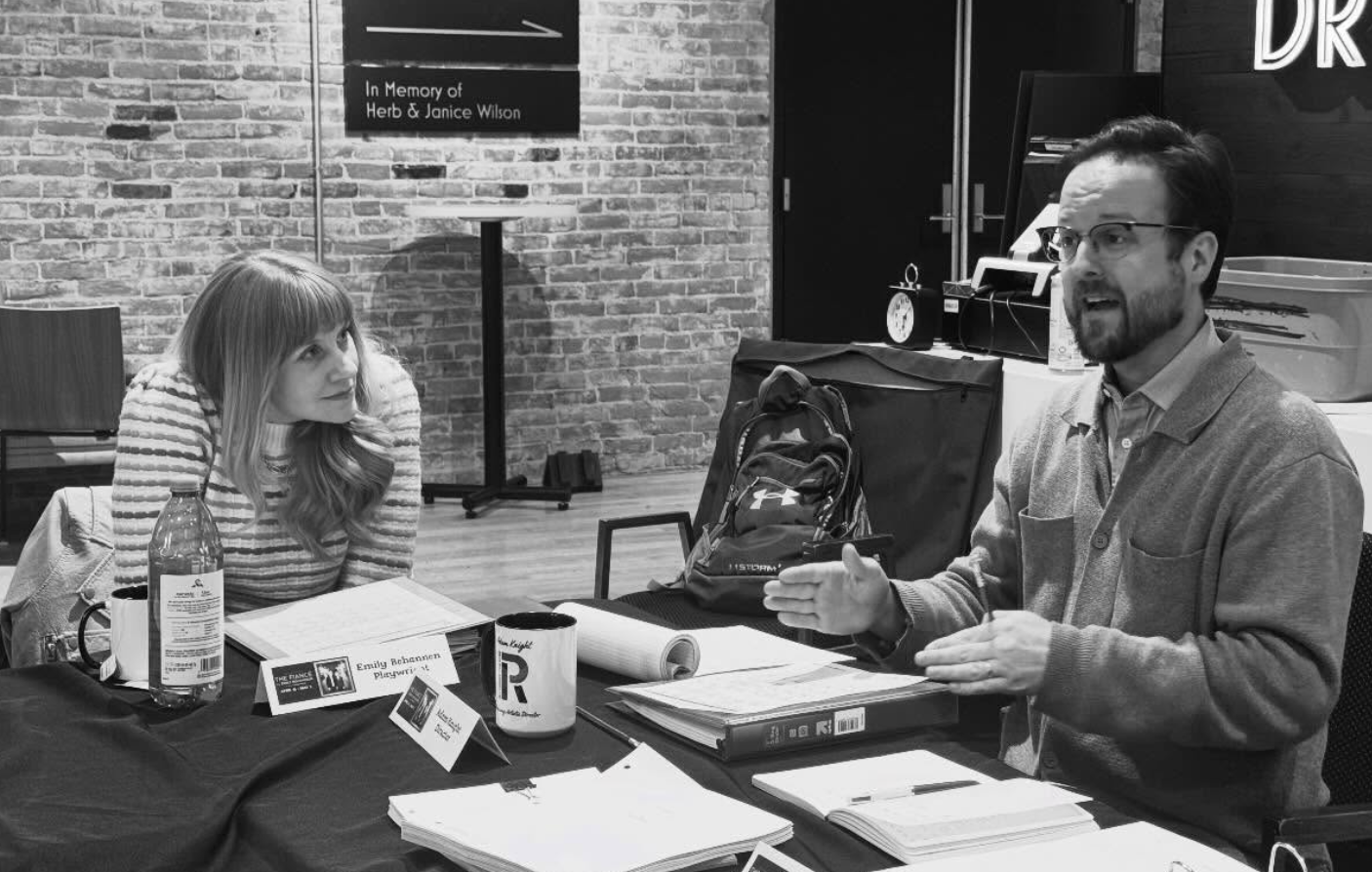
The Fiancé centers on Bea, a woman who moves to a retirement home and finds unexpected love there. Where did this story come from — was there a specific person, moment, or question that made you think, this needs to be a play?
EB: I first got the idea for this play when I was a student at the Juilliard School. I had recently broken off an engagement, and I was devastated. I thought I was never, ever, ever going to love again…I was 30. A few months later, my boss’s mom got engaged; she was 85 years old and got engaged to a man she’d met at her retirement home. They just had this amazing, wonderful time together, and so much fun – they were going out and doing all these things and going on trips. Seeing her go through that experience was very healing for me, because I thought: if it’s not too late for her, it’s not too late for me. I knew I wanted to see these two women in a play together: the 30-year-old who’s thinking she’s never going to find love again, and the 85-year-old whose life is just beginning. Then, as I was writing it, I also wanted to include the middle generation, you know, the sandwich generation that we talked about. I know so many women who are in this position where they have adult children, they’re going through a divorce, and their parents are also aging, and they’re dealing with that process. What I ended up with was three generations of women who are dealing with the loss of love and how to start a new life after that loss.
You’ve spoken about writing “characters seldom seen onstage.” What drew you to placing love, family conflict, and self-determination in the context of a retirement community, and what surprised you about writing Bea and Doug’s world?
EB: So, I interned at Manhattan Theater Club, which was the very first subscriber theater in the United States. I’d also been around lots of other subscriber theaters in New York City, and the majority of those audiences are in their later years, you know, 65 or above and retired. It had dawned on me before I wrote this play (I mean, years before) that we do plays for these audiences that aren’t about them. Whenever I see a character in their age group on stage, they are usually a minor character – maybe someone’s funny grandma or sassy grandpa. There really are so few roles, especially for women, in this age group. So I did really love the idea of writing a rom-com for the subscriber audience. I also wanted to create meaty female and male leads; we have so many wonderful older actors who deserve leading parts as well.
As I’ve worked on the play, a lot of things have surprised me. I always intended this play to challenge our stereotypes about aging, especially because I know so many people, especially women, who are living these dynamic lives, even in their 80s. That said, it’s so easy to fall into language that still supports the old narratives of ageism. Adam helped me meet up with some people from the Iowa City community who fell in love later in life. There were many things that I just never even thought of that they had to consider – so many tender and complicated questions – that I try to honor those in the play.
You’ve described plays as “stories in rooms the characters can’t leave.” What told you that this particular story belonged on a stage rather than on screen?
EB: I do think that this story could be a film. There are a lot more people to meet; there’s a lot more world to explore. I just think that I like the version of this story that is not all the characters and all their other lives. As a play, The Fiancé really focuses our attention on this one room where Bea is building her life. We don’t get to turn it off like TV and move on to something else; we have to live in it with her. And the set design for this play is so amazing. People who come will see that the set takes on a life of its own, in terms of really showing us how Bea’s starting to create a new life. We start with an empty space, and we end with a home. That’s the kind of stuff you just can’t do in other mediums.
Getting a play from a first draft to a world premiere involves workshops, readings, rewrites, and a lot of collaboration. What was the journey like for The Fiancé, and what changed most dramatically along the way?
EB: The very first time I heard the play, it was when I brought it into the Juilliard School. It’s worth mentioning that the first person to play Bea was celebrated Pulitzer Prize-winning playwright, Marcia Norman, who was my teacher. She read along with one of our greatest Jewish American playwrights, Josh Harmon, who was my classmate…he read Doug. So that will always stick in my mind as a particularly memorable moment. In 2013, Adam Knight’s Theater Company in New York, The Slant Theater Project, did a reading of the play as part of a reading series, which he directed. We had legendary actress, Mary Louise Burke, playing Bea, and Kelli Giddish, a friend of ours who is now on Law and Order, was the granddaughter. We’ve had a lot of amazing actors, and I’ve heard so many different interpretations of these roles. In this original draft of the play, Bea’s granddaughter also had a fiancé. She was newly engaged at the beginning of the play, and by the end, she decided to break that engagement. It was a fine draft, but I felt it was a little bit of a fight over whose play it was and what the play was really about. I just felt so much more interested in Bea’s story; so, I decided to make the granddaughter’s engagement already broken before the play starts, and I brought in a new character, who is her dad, who’s also the ex-husband of Bea’s daughter. I wanted a character who has a relationship with all three women and whose presence in the play is going to cause conflict…there’s a lot of juicy stuff with all three of our main characters. That’s the biggest change that the play has gone through, and I think it was a change for the better. Then, when Adam asked me to come out to Iowa City in 2024 to do a workshop of the new script, it was really like testing those changes, seeing if indeed this was the direction the play needed to go. We loved it.
A world premiere is a rare and electric thing — the audience isn’t just watching a play, they’re witnessing something that has never existed in front of people before. How do you think about the audience’s role in that moment, and when the lights come up, and people walk out into the night, what do you most hope they’re carrying with them?
EB: The final act of the play really happens after the show is over; it exists in the conversations that audience members are having. One of the things I love about this play is that everyone I talk to about it tells me a story back. I’m hoping that this play provokes some thought, whatever generation you are closest to, and challenges some stereotypes of aging. I hope it makes you think about things that have happened in your life, because most of us have either been in one of these situations or we know someone close to us who has.
In terms of the play itself and its development, the audience is not just an observer at a world premiere…they are active collaborators. I am listening to their experience. I’m noticing if they’re super engaged, if they’re laughing, if they’re bored, if they’re shuffling and looking for mints in their bag. I’m noticing if they seem confused about anything. I also like hearing the conversations of people talking about the play. It’s not that I take all of this as gospel, but it’s true that if many people are reacting to the same part of a play in a way that’s not wholly positive, then to me, that says I need to be clearer. Also, a lot of the feedback is nonverbal, and the audience is not necessarily aware that they are participating in this way…but they are, and it’s exciting. I think if you’re sitting in an audience in a world premiere, you’re watching something being built in flight.